ENSO OS ships with agents, skills, and chains already built. You assign, they execute, you approve. The work gets done. And stays learned.
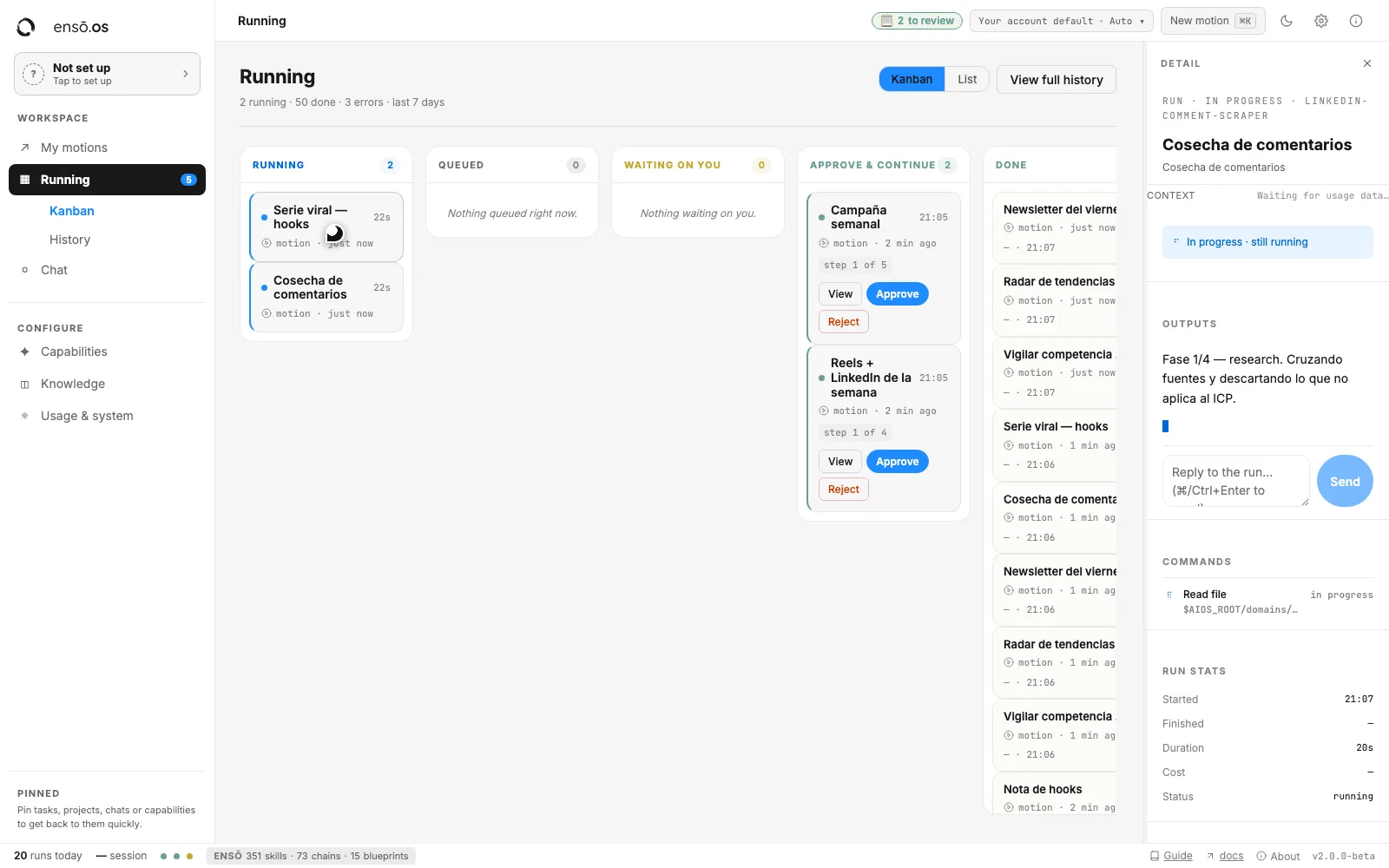
Recorded from the real product, no mockups.
Agents aren't passive tools: they pick up tasks, report progress, and change status. Your board shows humans and agents working side by side, and you operate like you're running a team.
A task to an agent or a person: same gesture, same board. Name it, pick the capability, launch.
Full cycle: queued, picked up, running, done or failed. Blockers report themselves, on time.
Agents propose; people approve. Every piece of work stops at a human gate before it goes out. Reviewing is faster than doing, and judgment never leaves the team.
A board tells you where everything stands: what's running, what's waiting for review, what's queued. No asking, no chasing.
Approve & continue: nothing moves forward without your sign-off.
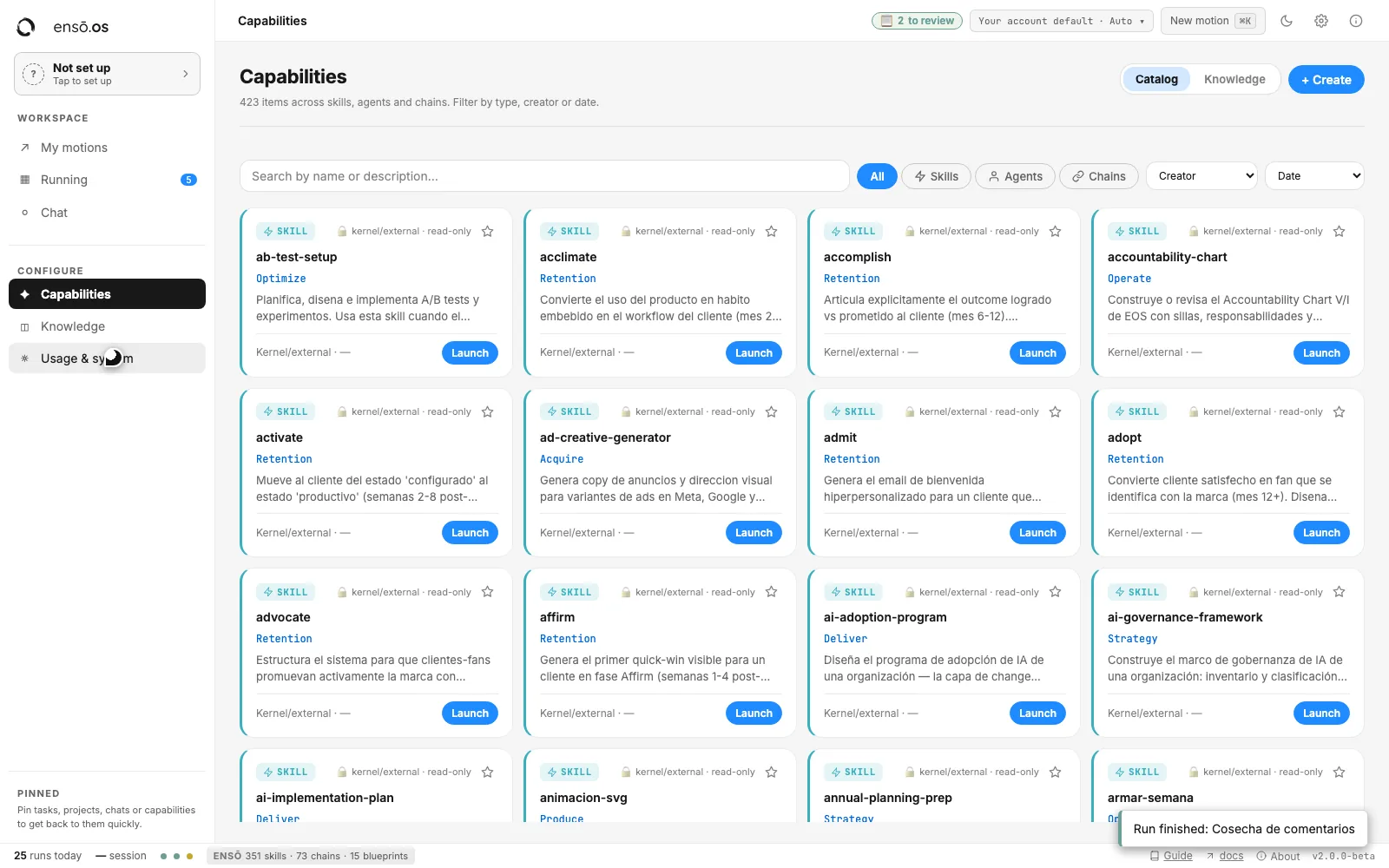
You don't start with a blank whiteboard. ENSO OS ships with a working catalog organized by the job it does (content, sales, research, operations), with preconfigured agents to run them.

A capabilities catalog: search it, filter it and launch from it.
Browse by the job you need done, activate the skill, and it runs inside your workspace. Your team launches the same capability the same way, every time.
Your processes aren't generic. When the catalog doesn't cover how your company works, we tailor the skill to you: your voice, your rules, your data. It joins your catalog and your whole team can launch it.
Every area of your business gets its pod: agents with a clear role, and you in command. You give one instruction; the orchestration layer moves the rest.
Illustrative structure: you build the pods from the capabilities catalog.
Every piece of work becomes a memory and a standardized process. Today's correction is tomorrow's process.
Knowledge: your team's shared memory, searchable by anyone.
One conversation and one context, shared by the team, not trapped in a personal tab.
Everyone on your team comes in with a role: you decide who sees which knowledge and who approves which work, transparently and traceably. One operation, not ten loose accounts: nobody starts from zero, because what one person teaches stays for the rest, and nothing is trapped in anyone's personal account.
It works where you work: your CRM, Notion, email, your documents, with your own AI provider. Your keys, your account, your choice of model.
Software alone doesn't change how a company works: people running it well does. That's why ENSO OS comes with training and guidance, not just a login.
It isn't documentation to read on your own: we sit down with the people who are going to run it, on your company's real work.
For companies that want the system installed hand in hand, there's Master: 16 weeks designing the flows with your team, testing them against real work, and transferring the operation. Your team ends up running it, not depending on us.

Placeholder: the video of a guidance session goes here.
All of this exists for one thing: so you can leverage your work and free up your time. So that while your business grows, you don't lose your freedom.
Tools are meant to make us free, not to make us more and more enslaved to them. A tool that needs you on top of it all day didn't give you time back: it got you another job.
That's why the ensō: the zen circle drawn in a single brushstroke, with no retouching. And that even so never quite closes: it's drawn with an opening, the space for what's still to come.
Growth is the means. The person's freedom is the end.


Frameworks, templates, and tools from the ensō method. The English library is on its way: join the waitlist and we'll send it as soon as it's ready.
No account, no card. Just your email.
Access opens in batches. The waitlist is the door: join it and we'll let you know when your spot is ready.
A chat answers you, in your tab, and forgets. ENSO OS executes work with state: the task lands on a board, an agent picks it up, reports progress, waits for your approval, and leaves the process saved for next time. You still pick the model: the OS orchestrates, it doesn't replace your AI provider.
No. Every piece of work passes through a human gate before it ships: agents propose, people approve. What changes is how much the same people can cover, not how many people you need.
No. You assign tasks and review results, like with a team. Agents come prebuilt and skills are added without code.
Your own AI provider: you use your keys and your account. The OS orchestrates; you choose the model.
You work with your own AI provider, with your keys and your account: the terms covering your data are the ones you already have with that provider. Inside the workspace, you decide who sees which knowledge and who approves which work.
The ones you already use: Notion, Slack, Gmail, Drive, Sheets, WhatsApp, HubSpot, Make, n8n, Airtable, Supabase, and Instagram, among others. Nothing to migrate, no stack to change to get started.
Yes. Turn on what already ships in the catalog, or build your own capabilities without writing code. When a process is very much yours, it gets adapted to your voice, your rules, and your data, and stays available to the whole team.
You see it. The board shows what ran, what failed, and what's waiting for review, with the error reported on the card. Nothing ships without your approval, and the correction you make becomes the process for next time.
Yes. The smaller the team, the more it matters that nobody starts from zero: what one person figures out stays available to everyone else instead of dying in their chat history.
That's what our guided implementation program, Master, is for: over 16 weeks we design the flows with your team, test them, and transfer the operation. Mention it in your use case when you join the waitlist.
We save your name, email, and use case, and write to you when access opens. Nothing else: signing up doesn't create an account or commit you to payment.
Access opens in batches. Sign up and we'll write to you when your spot is ready.
No account, no download, no card. Just your email.